You are staring at a spreadsheet, then at a map on another screen. The numbers look decent and the routes seem logical, but you can't shake the feeling that some of your jobs are losing you money. Between drive time, fuel costs, and that one client who is just a little too far out, you know your margins are getting squeezed. But where? And by how much?
It is a kind of operational blindness, a common growing pain for businesses in the pet waste removal industry. In a field this competitive, guessing about profitability is not a strategy. It is a problem that specialized platforms like ScooPilot are built to solve, helping operators move from intuition to data-driven decisions.
Why is Route Efficiency So Critical in the Growing Pet Waste Removal Market?
The pet waste removal industry is not a side hustle anymore. It has grown into a professionalized service sector with rising customer expectations. This growth brings tougher competition and new operational pressures. Simply getting the jobs done is no longer enough; success now depends on true operational efficiency for service business growth.
Rising fuel costs, higher labor expenses, and the constant need to service more clients in less time have made smart route optimization for pet waste business operations essential for survival. Inefficient routes do not just waste gas; they waste your most valuable asset: time. Every extra minute spent driving between stops is a minute you are not servicing another paying customer.
That is why modern pet waste removal software is less of a luxury and more of a necessity, providing the tools to maximize both route density and profitability.
What is a Route Profit Map and How Does it Work?
Think of a route profit map as more than just a route planner. Instead of only showing the shortest path between jobs, it visually breaks down the profitability of each stop on your route.
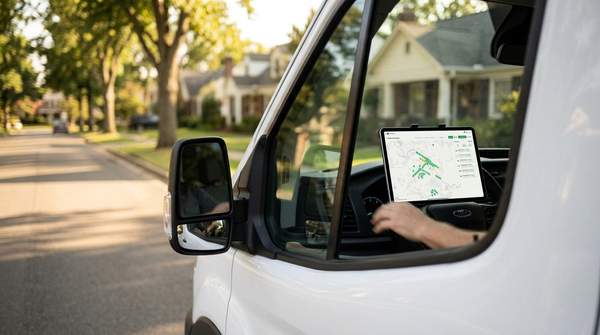
On a platform like ScooPilot, this appears as a color coded map where each customer location is marked green for profitable or red for unprofitable. This simple visual feedback lets a business owner see, at a glance, which clients are boosting their bottom line and which ones are draining it.
The system works by pulling together multiple data points for each job, not just the price a customer pays. ScooPilot calculates the true cost of service by factoring in technician wages, the average time spent at the property, and the drive time and fuel costs to get there. This gives you a real-world financial picture of your daily operations, turning abstract numbers into an actionable visual guide.
Technology Deep Dive: The Engine Behind Profit Mapping
What makes a route profit map innovative is not just the visual display, but the math running in the background. At the heart of ScooPilot is a Cost-Per-Stop Calculator. This calculator separates profitability-focused software from simpler scheduling apps by assigning a true cost to every visit a technician makes.
Here is how it works:
- Labor Costs: The software takes the technician hourly wage and calculates the cost for the exact time spent on-site.
- Drive Time and Fuel: It calculates the time and distance from the previous stop, then applies current fuel cost estimates and vehicle data to find the real travel expense.
- Revenue Data: This total calculated cost is then measured against the revenue generated from that specific service.
The result is a granular level of customer profitability analysis that is impossible to replicate with spreadsheets or generic software. While other tools might build the most geographically efficient route, ScooPilot focuses on creating the most financially efficient one. The founders, who ran their own pet waste business with over 200 weekly stops, built this feature to solve the exact problem of hidden financial leaks in daily routes.
Is Specialized Software Like ScooPilot Better Than a Generic Tool Like Jobber?
While generic field service software like Jobber can be a decent starting point for many businesses, a one-size-fits-all solution often misses the critical, profit-driving details of a niche industry like pet waste removal. You can use Jobber for pet waste removal, but you will miss out on the specialized tools that address industry-specific challenges.
A platform like ScooPilot, built specifically as poop scoop business software, has clear advantages:
- Focus: Generic tools are made for dozens of trades, from plumbing to lawn care. ScooPilot is built exclusively for poop scoop operators, with features designed around their specific workflow.
- Industry-Specific Tools: ScooPilot includes a Yard Measurement Tool for accurate remote quoting, profitability mapping, and route density logic that generic software lacks.
- Cost Structure: Many generic platforms use per-user pricing that penalizes growth. As you hire more technicians, your software bill skyrockets. ScooPilot uses a tiered, flat-rate model designed to be more scalable and cost-effective than per-seat software fees.
How ScooPilot Pricing Helps a Growing Pet Waste Business Save Money
As a service business scales, watching overhead software costs climb with every new employee can drain profits. Traditional per-user pricing models used by competitors like Sweep & Go mean that adding a second, third, or sixth technician forces your monthly software bill up linearly for every single seat.
ScooPilot tackles this problem with a tiered, flat-rate pricing model starting at $29/mo for solo operators, moving to the Crew plan at $49/mo covering up to 3 staff members, and the Fleet plan at $99/mo covering up to 6 staff members. Instead of charging per individual user, these tiers let you add team members up to the plan limit without facing punishing per-seat fees.
For one pet waste operator in Loudoun, VA, the financial impact was clear: switching saves significant overhead while delivering advanced features. This predictable tiered structure makes ScooPilot a compelling alternative for businesses focused on protecting margins as they expand.
How to Identify and Fix Unprofitable Routes in Your Poop Scoop Business
Having the data is one thing; acting on it is another. A tool like ScooPilot Route Profit Map turns the guesswork of fixing unprofitable routes into a clear strategy.
First, you use the map to spot the red stops, which are the clients costing more to service than they generate in revenue. Then, you can drill down into the data to figure out why. Is the client simply too far from your other customers? Was the job underpriced for the size of the yard? Is a technician spending too much time at that location?
Armed with this information, you can take specific actions. You could approach the client about a price adjustment, reschedule their service to a day when a technician is already in their neighborhood to improve route density, or make the strategic decision to part ways with a deeply unprofitable customer to free up resources for better ones.
The Bottom Line
Transitioning a pet waste removal company from guesswork to a data-driven operation ultimately comes down to understanding the true cost of every stop on the map. By leveraging specialized features like ScooPilot, operators can eliminate hidden leaks, protect hard-earned margins, and build a scalable business that thrives even as competition increases.
If you want to take a closer look at your own numbers and see how your current routes stack up, exploring a platform like ScooPilot is a practical next step to find clarity in your daily operations.