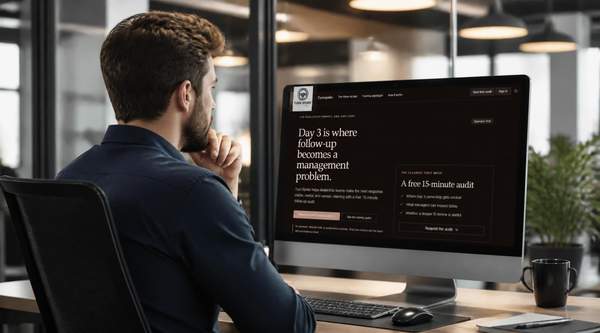
What if the biggest threat to your company’s future isn’t a competitor, but the very ‘hustle’ that got you here? For many founders of service-based businesses, the same relentless effort that sparked early growth eventually becomes a ceiling. Relying on improvisation and memory creates a hidden "hustle tax" you pay in missed opportunities, team inconsistencies, and founder burnout. As leaders search for a more durable way to scale, the conversation is shifting from sheer effort to permanent systems. One emerging solution comes from Sales Boss, which focuses on installing a disciplined business operating system instead of just coaching people to work harder.
Sign 1: Your Sales Chart Looks Like a Rollercoaster
One month your team is unstoppable, and the next it’s a struggle to hit basic targets. That kind of revenue volatility is a classic symptom of a business running on personality and momentum instead of process. When sales hinge on one person's 'vibe' or the founder's direct involvement, the results are always going to be unpredictable.
The only reliable antidote is a documented, enforced sales process. It’s about moving beyond loose guidelines to what Sales Boss calls "execution playbooks," a defined, repeatable standard for handling every lead, structuring every conversation, and advancing every deal. The goal is to make success a function of the system, not just individual heroics.
Sign 2: The Company ‘Brain’ Is Your Brain
If you're the only one who knows how everything *really* works, your business has a single point of failure. Critical processes, client history, and next steps all live in your head, making it impossible for you to step away and difficult for your team to work autonomously. It's no surprise that a 2024 study from WithDouble revealed over half of startup founders suffer from burnout, with nearly 60% admitting it hurts their ability to lead.
That's what happens when one person carries the entire operational load. Getting that knowledge out of the founder's mind and into a permanent business operating system is critical for survival. It’s a principle Sales Boss founder Jacob Gaspard, an 8-figure operator, used to build his own companies. He was driven by the need to create a business that could run without him, a lesson made urgent by a personal health crisis that highlighted just how fragile founder-led operations can be.
Sign 3: Team Accountability Is a Subjective Conversation
Without a clear, measurable standard, managing performance feels like guesswork. You know when things are going poorly, but can you prove it with data? When the sales process is undefined, accountability becomes a matter of opinion, which leads to frustrating conversations and inconsistent results. Real accountability requires a non-negotiable standard.
The Sales Boss methodology, for example, is designed to provide 100% team visibility on deal flow, which makes performance metrics objective. As a multi-location salon owner working with the company reported, with this level of clarity, "Behavior changed in two weeks." It just shows how quickly teams can align when the standard is clear and visible to everyone.
Sign 4: You're Paying a Hidden 'Hustle Tax' on Every Lead
Every slow reply to a lead, every prospect who isn't followed up with systematically, every minute your team spends just figuring out what to do next, it's all a form of tax. This 'hustle tax' is the cumulative cost of operational inefficiency. It won't appear on a balance sheet, but it quietly drains profitability and strangles growth. One of the fastest ways to recover this lost revenue is to systematize lead management and sales follow-up. Documented case studies show that installing a disciplined system can produce dramatic results. One client, for instance, saw a -71% reduction in speed-to-target, or lead response time, a critical factor for optimizing lead conversion.
Sign 5: Scaling Feels More Chaotic Than Exciting
Hiring new people should accelerate growth, but in a business built on hustle, it often just adds to the chaos. Without a formal operating system, onboarding is inconsistent. New team members are forced to learn by trial and error, often picking up the same bad habits from the ad-hoc process already in place. This chaos is a huge barrier to scaling. Real growth requires a stable foundation, a set of standard operating procedures for sales and operations that can be taught, measured, and improved. Only then does adding headcount lead to predictable, profitable expansion instead of just more overhead and complexity.
Is Investing in a System Like Sales Boss OS Worth It?
For any small or mid-sized business, the big question is whether the cost justifies the return. But when you're evaluating a business operating system, the analysis has to go beyond the monthly fee and focus on the ROI. The alternative isn't 'free.' It's the ongoing, often invisible, cost of inefficiency. For example, documented 'Field Results' from Sales Boss clients show outcomes like a +38% lift in booking conversions. In one particularly striking case, a life insurance agent went from $4,000 per month to $28,000 in just four days. An investment that eliminates the 'hustle tax' and creates predictable revenue can pay for itself quickly, simply by capturing opportunities that used to be lost in the chaos.
The Methodology: More Than Just Software or Coaching
So what exactly is an 'operating doctrine' in business? The market is already crowded with generic CRM software and motivational sales coaches. The Sales Boss model is different because it aims to be neither. It’s positioned as an "install" of infrastructure, not just another tool you subscribe to. The methodology starts with a deep diagnostic phase (the free 'Audit') and then moves to putting concrete assets in place.
- Operational Infrastructure: Think of this as the digital plumbing of the business. It often involves pre-configured CRM systems tailored for industries like Med Spas, Trades, or Insurance. The goal is to provide a CRM alternative for service businesses that's ready to use, not a blank slate.
- Execution Playbooks: These are the step-by-step standard operating procedures for the entire sales cycle, from first contact to close. They standardize the 'how' of selling so that results are consistent across the whole team.
- Pressure Systems: This is the accountability and reporting framework that makes performance visible and non-negotiable. By making the metrics transparent, it helps create a culture of high performance.
Who Benefits Most from the Sales Boss System?
An intensive system installation like this isn't for every company. It’s designed specifically for owner-led service businesses that have hit a growth ceiling and are feeling the pain of running on pure hustle. The system tends to work best for:
- Founders in industries like Trades, Insurance (Life & P&C), Salon & Spa, Med Spa, and Coaching/Consulting.
- Business leaders who are tired of inconsistent sales and ready to commit to a single, disciplined standard of operation.
- Operators who know they need to move from founder-led sales to a systematized sales team to reach the next level of growth.
- Companies that need greater operational efficiency to combat rising labor costs and higher customer expectations.
The future of service businesses won't be defined by who works the hardest, but by who works the smartest. As technology and customer expectations keep evolving, the competitive edge will go to companies that replace chaotic hustle with the discipline of a real operating system. The path forward is clear: predictable, scalable growth is built on a foundation of systems, not on the heroic, and ultimately unsustainable, efforts of any one person.